Week 10 - Nov. 30
Module 3 Communicating the Past
Location Our classroom
Theme Archaeogaming and other Playful Approaches
This week represents a kind of pivot point in the course. So far, we’ve largely been focused on the moment when observations in the field become data, and then on the kinds of manipulations of those data we might do. In this module, we’re going to zoom out a bit and consider how we get from that level of detail to larger scale macroscopic stories about the past. Who gets to tell the story matters.
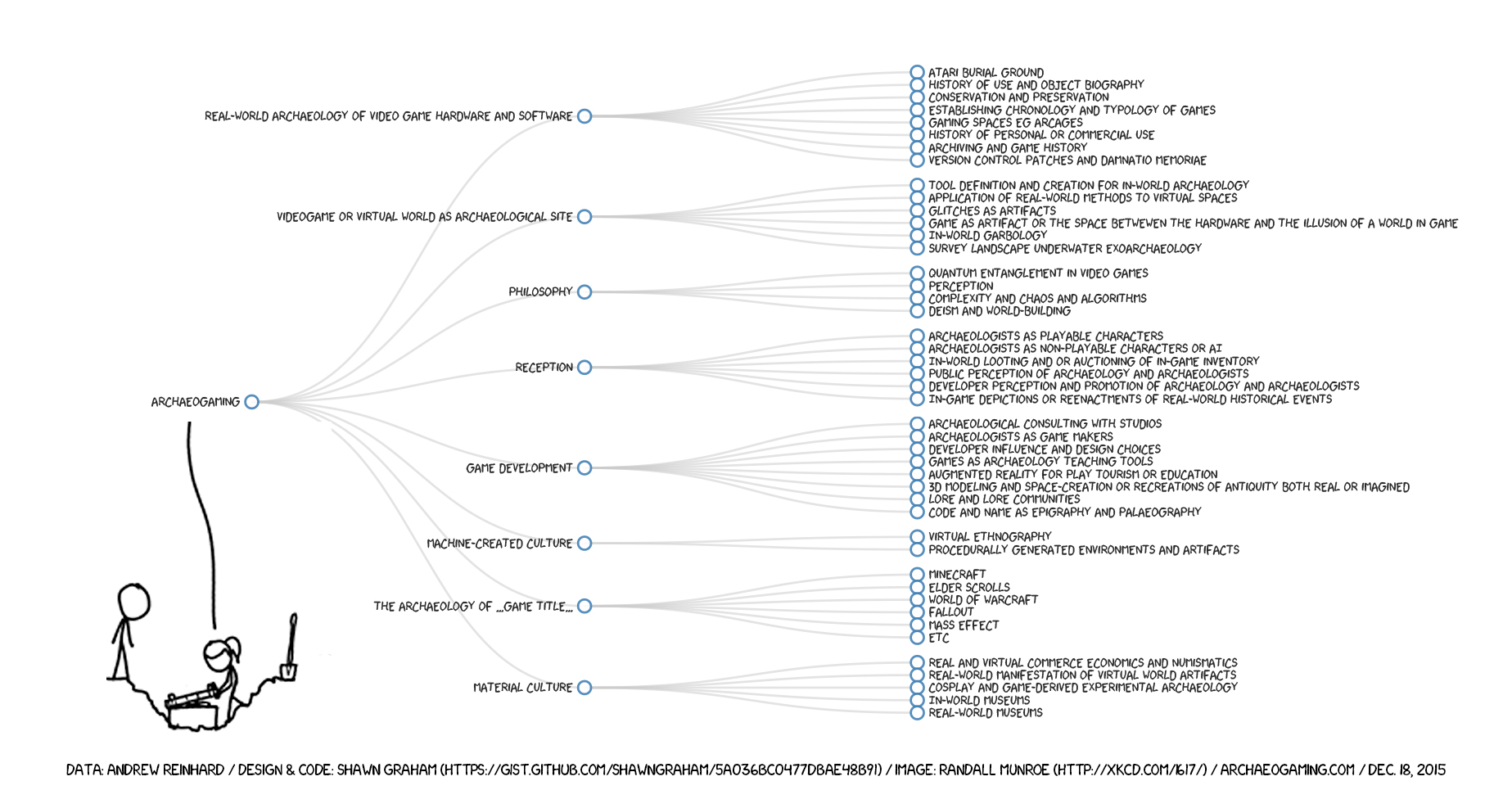
We’ll start this week with ‘archaeogaming’. There are a lot of dimensions to archaeogaming. I don’t know if it’s still on Netflix, but the ‘Atari: Game Over’ documentary is worth a look because it is a case of quite literal archaeology of video games.
Most of the time, no one excavates physical video games. But we do do work inside video games, and archaeologists do sometimes help design video games - Tara Copplestone, in ‘Designing and Developing a Playful Past in Video Games’ has written on the tension between good archaeology and good game design, and it’s well worth your time to read.
For my money, a video game does one thing really well: it teaches the player how to play it. If you’re really good at the game, you’ve internalized its representation of the world. And that’s why archaeologists need to think about storytelling, and ethics, and representation in video games.
Have Read for Today
- González-Tennant, Edward. 2010. Virtual Archaeology and Digital Storytelling: A Report from Rosewood, Florida. The African Diaspora Archaeology Network, September 2010 Newsletter. link
- Graham, S. 2020 An Approach to the Ethics of Archaeogaming, Internet Archaeology 55. https://doi.org/10.11141/ia.55.2
- Perry, S., Simandiraki-Grimshaw, A., Morgan, C., Taylor, J. S., Fadioui, A., Foket, L., … Clough, A. (2025). ‘Towards New Futures for Archaeological Data Production: Challenging Archaeonormativity through Storytelling’ Journal of Field Archaeology, 1–20. link.
The Plan
- find an online game that features memorialization in it (maybe there’s a cemetery in it) at https://borogove.io/. Remember our graveyard recording forms? Could those be used/useful to explore how memory works in a game? Think about, and record, the ways memorialization is constructed in these games, and how it is similar/different from the ‘real world’ data.
- or build your own text-based game using the Ink scripting language (check out the paradata for Buried, by Tara Copplestone and Luke Botham)
- or Go play Nothing Beside Remains. Map the site; try to understand the ruins by situating them in context with one another. Write/craft a research report of around 250-400 words. Then, think about the kinds of literary tropes you depended on in order to write that report. What does this imply for how ‘regular folks’ might understand - or be helped to understand - about archaeology?
- or give this solo ttrpg of mine a whirl: The Cave analog version and game pad; all-in-one-version. Here are the design documents for this style of game.
- or give sonification a try with TwoTone; you load a csv of data into it, and then add ‘voices’ for each column of data. You can assign instrumentation and range and tempo. The result can be downloaded from the site as an mp3 file. You might get an error about ‘midi’ requiring a site permission. Just hit the note icon, add another row of data, and you should be able to just ignore the error. Alternatively, you can use the ‘sonification’ python notebook to achieve something similar.
There’s something to be said for lo-fi playful experiences. Hmmm?
Skill Building
- use https://borogove.app/ to build an Ink powered game (here’s a guide to the features of Ink) that captures what it was like to be working at the Billings Estate. You don’t have to hit the ‘publish’ button. The game script saves in your browser (but don’t clear your browser’s memory/cache). Use the ‘share’ button to save your game somewhere else on your computer.
# TITLE: Cat Got my Ink
# AUTHOR: Your Name

Your cat is sitting on your keyboard. Again.

She looks up at you with an expression of pure innocence, as if she hasn't just deleted three paragraphs of your interactive fiction novel.

* [Gently lift the cat]
  You carefully scoop her up. She purrs, victorious.
  There are now seventeen extra 'g's in your document.
  -> END

* [Offer a treat as distraction]
  You shake the treat bag. Her ears perk up instantly.
  She leaps off the keyboard... Stepping on Ctrl+S on her way down.
  At least your work is saved.
  -> END
(code snippet from RemyVim)
If you’re interested, I built a generator for solo journaling RPG games as a website; link You’re welcome to play with that; it’s a bit janky though.
Homework By Friday at noon, have your materials for this week complete and in github. You can use the ‘share’ button to download all of the files for your game, which can then be dropped into your compendium.