


A quick word on mortuary archaeology
I want you to gain some experience of collecting data, and of how data models (or our expectations of what we’ll find) influence the subsequent work that we can do with the information that we collect. ‘Data’ means things given but the goal (a goal) of this exercise is to see this information more like ‘capta’ or things created/crafted/captured.
Archaeology has some well established models for capturing the observations made at the trowel’s edge. In the UK for instance (where I did most of my archaeological training) the ‘single context’ recording system as developed by the Museum of London Archaeology Service is more or less used (with variations) everywhere. (Here’s the manual).
We clearly can’t dig anything (and besides, it takes time to obtain a license to excavate in Ontario; looking at monuments in cemeteries however doesn’t fall under the rubric of the archaeological licensing scheme). We will be looking at archaeological data collected by others (from places like the Archaeological Data Service), but it seemed to me that you should experience just how much variability, reflexivity, and creativity is involved in trying to systematically collect information. Morgan and Eddisford argue (2019) that
the introduction of single context recording not only had a dramatic impact on the way in which archaeology was undertaken, but also revolutionized the way social relations on site were structured. Single context recording promotes individual empowerment of diggers, allowing them to contribute to collective knowledge construction on site. Equally, it promoted a more horizontal management structure.
In a way, the scheme that we are going to use (adapted from ‘Discovering England’s Burial Spaces’ is similar to what Morgan and Eddisford say about single context recording: one grave at a time, you (plural) build up a broader picture of what is going on. But recognize this too: how we record data has an impact not just on the past, but the present (see also Perry 2018, 217)
Mortuary Archaeology
The study of graveyards is one point where history and archaeology intersect, as both disciplines have their own bodies of literature connected with exploring how humans have dealt with their dead. I remember being taught as an undergrad the concept of seriation with reference to motifs on New England headstones (‘Death’s Head, Cherub, Urn and Willow’ by Deetz and Dethlefsen.)
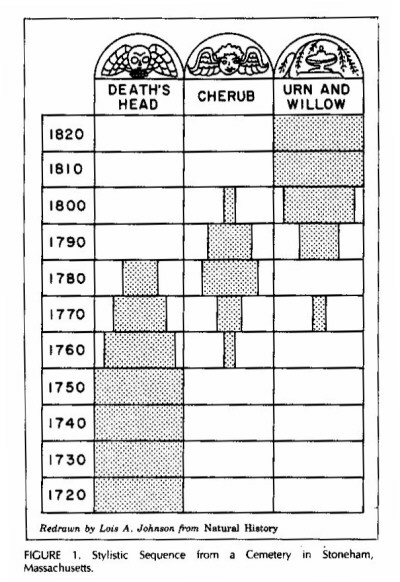
The count of headstones with different motifs, when organized according to date of death, demonstrates how fashions evolve even within gravestone motifs. Which also means you can use a motif to suggest a likely date for a stone…
Now, mortuary archaeology as a branch of bioarchaeology has tended to focus more on the human remains (an overview by Bettina Arnold and Robert Jeske is available here).
In my research project with Damien Huffer, (The Bone Trade Project) we looked at how and why people buy human remains (which they do these days over Facebook and Instagram) using computer vision and machine learning. Many of the people whose remains are now being traded were stolen from their graves; many never even made it to the grave (people who died homeless, for instance, in the late 19th and early 20th centuries, could be claimed by schools of anatomy for dissection).
Ontario has a history of grave robbing as well - I found this notice in a local newspaper (the Shawville Equity):
“Dr. Eberson, a dentist well known through-out the Ottawa Valley, was found drowned in the Rideau Lake near Portland recently, and his body was interred in the cemetary at that place. A few days since it was found that the body had been stolen by human ghouls. The coffin was kicked in and badly damaged by the graverobbers… No trace of the body has yet been discovered.“ – Shawville Equity, October 9 1890
Katie Daubs, writing in the Toronto Star, has a long piece on the history of grave robbing in Ontario.
A quick look at graveyards and gravestones therefore sets us up to talk about digital archaeology in a number of powerful and compelling ways.