


Learning Outcomes
The four points below address your analytical ability, your engagement with methodology, collaboration, argumentation, and professionalization.
- Situate the emergence and evolution of digital archaeology within the historiography of archaeology more broadly (analytical ability, argumentation)
- Implement and contribute to a contemporary archaeology via digital archaeological methods (methodology, collaboration, professionalization)
- Investigate data, artifacts, and primary sources, using the methods/techniques/perspectives of digital archaeology and digital humanities (analytical ability, methodology, collaboration, professionalization)
- Collaboration: digital archaeologists collaborate to troubleshoot or develop technologies, and through collaborative peer learning (modeling open practices to data sharing and reuse), learn to build upon each others’ work in a collaborative fashion. (collaboration, professionalization, methodology)
Assessment
You are assessed on three elements:
| Element | Weight |
|---|---|
| Personal Digital Archaeology Project (PDAP) | 30% |
| Consolidation Document x2 | 20% each |
| Final Exam | 30% |
How this works
I want you to explore and experiment. I want you to push yourself out of your comfort zone, and become comfortable with trying things out. The more weeks you engage in good-faith, the better you will do. The grading is designed to reward experimentation and reflection on what works and what doesn’t. Good faith means: your own writing warts-and-all. Machine-generated text is not good faith.
Digital archaeology is a social practice. We work together, we help each other, and we learn to ask for help: no heroic lone scholars here!
There are a lot of you
I want to get to know you and your work and how you’re approaching things. Sometimes people don’t ask for help even when they need it. I might ask people at random to chat with me about their weekly work. This is a random process and does not imply that I suspect anyone of misconduct. But you don’t have to wait on me to call on you - you are always welcome to join me for coffee on Wednesday mornings at the Library Pagebreak to talk shop, shoot the breeze, complain about the Senators.
Personal Digital Archaeology Project
In the same way that there are Roman archaeologists, Greek archaeologists, Palaeolithic archaeologists, Historic archaeologists, Maya archaeologists and so on, there are contemporary archaeologists. These are folks who look at the materials surrounding us in the here and now, and deploy archaeological methods and theories for understanding what they’re seeing. I’m one myself (given my work on the human remains trade, and the archaeology of the International Space Station, and of Mt. Everest). PDAP lets you practice the skills and ideas you learn about digital archaeology on something you’ve observed around Carleton.
Deadline: End of November. You will submit a link to a Github repository containing your materials to me via email with the subject line ‘PDAP - your_name - ready for viewing’. This repo may if you wish be made private.
What you do
- define a question of interest to you
- show how you have designed and built a data collection strategy/tool
- collect data and transform it
- build a one-page website to communicate your findings
- document 1,2,3,4 and your choices/issues encountered and associated implications in a paradata.md document.
- complete practice-based exercises to build your skills as you go
Practice-based exercises
These exercises are not about finding the ‘right’ answer. Your process matters more than the outcome. Code breaks, approaches go out of date, things change: this is expected. How you deal with that is what I’m trying to teach you. When something breaks, explain what you expected to happen and what actually happened, and try to understand that space between. Ask for help from me, your peers, or your TAs. You learn more from a broken pot that the one in the museum display case.
If something doesn’t come within 30 minutes it won’t come in 3 hours. Ask for help. Show the problem to someone else. Close the computer, go touch grass. Come back fresh. If it still doesn’t come together and you don’t have anyone handy to help you out, document what you were doing, all of the steps, create screenshots, etc. Digital archaeology is a matter of practice and exposure. It might not click now, but it might click later. Process is what matters.
There are about 23 exercises; that number might fluctuate as I see how the class progresses. Some are easy, some are harder. Pick what interests you and give it a whirl. Everyone comes to digital work with different levels of exposure. A good-faith effort from someone who already knows Python looks different than for someone who podcasts.
What you submit (weekly compendium, in Github)
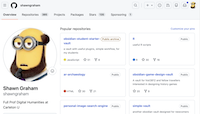
You will get your Github repository set up in week 1. You will add user ‘shawngraham’ as a collaborator (my avatar is a bearded Minion). Add our TAs.
Your practice-based compendium is a subfolder in your Github repository. Each week it must contain:
- Log.md: A file documenting which exercises you tried and what happened (the literal process and outcomes). This can be bullet-point.
- Files: any files you create in the course of trying an exercise
- Overview.md an overview note connecting what you tried to the questions raised by what you’ve read, what I’ve said in class, and/or other exercises you’ve tried. Whose code or insights or help did you build on? The overview document can be bullet-point.
Then, working towards your own personal research project:
- in your main PDAP repository, update with any relevant work completed that week. You might find it easiest to keep this as a kind of journal or diary; call it PDAP-update.md.
The three elements of the practice based exercises plus your PDAP-update constitute a minimum good-faith effort for a given week (in week 5 and 9, the completion of the Consolidation documents). We count the number of good-faith weeks to date in Week 5, Week 9, and Week 12 (thus giving you a bit of lee-way on the timing).
| GOOD-FAITH WEEKS | GRADE | POINTS |
|---|---|---|
| 12 | A | 26 |
| 11 | A- | 25 |
| 10 | B+ | 23 |
| 9 | B | 22 |
| 8 | C | 19 |
| 7 | D | 16 |
| 0-6 | F | - |
Feel free to use the checklist document to track your progress.
How to let us know that your work is ready, ie, how to submit weekly work
Please fill in this google form letting us know you are ready for us to review your materials..
Consolidation documents (x2)
At the end of each module, you will write a consolidation document during class time by hand, without devices (subject to accommodations).
These documents are opportunities to look back over the previous weeks and work out what you’ve been learning, where the problems have been, and what this all means for you going forward; you draw on your own experiences/exercises, on the readings, and on the lectures; you make and explore a claim (or claims) about how digital archaeology relates to the broader discipline.
See the relevant week for details on what the different consolidation documents ask for, and guidance for what constitutes a good consolidation.
Final
The final exam takes the form of one last consolidation document, 3 hours. It will in particular ask you about your PDAP.